Why Ages 8–14 Matter
And What Most Programs Miss
Your athlete's speed, coordination, and confidence aren't just built through practice and games. They're built — or missed — inside a biological window that doesn't reopen. This guide explains what that window is, why it matters, and what you can do about it.
She's 11. She's been on competitive teams since she was eight. She has the physical tools: the height, the leg length, the body that looks like it should be fast.
But she's not. Not yet. When she runs, something looks… effortful. Heavy. She's working hard, covering ground, but nothing looks effortless. Nothing looks explosive. Other kids are beating her to the ball, and you can't figure out why, because she's clearly trying.
The speed is in there. You can feel it. But it's locked inside a body that can't access it. She's driving with the brakes on.
Or maybe you're watching a different version of this. In warm-ups, she looks great. Long strides. Powerful. Coaches have always said she has "good speed." But somewhere around the second half, the third shift, the late minutes, something changes. The legs get heavier. The first step disappears. Kids who were slower in warm-ups are now beating her to the ball. She looks like a different athlete.
Either way, the question is the same:
"Why doesn't it show up when it matters?"
If any of that sounds familiar, you're not alone. It's one of the most common things parents describe when they reach out to us.
And the answer isn't what most people expect. It's not about effort. It's not about talent. And it's usually not something more practice or more games will fix.
It's about what's happening, or not happening, inside the body. Specifically, inside the nervous system. And there's a window of time when that system is most ready to be shaped — and a set of qualities that either get built during that window, or don't get built at all.
This guide will explain what those windows are, why most training programs miss them, and what actually works. It's based on two decades of coaching — including four years inside China's Olympic speed skating program, adapted for competitive youth athletes here in Calgary.
Driving With the Brakes On
The most common version of this problem isn't an athlete who fades late. It's an athlete who was never fast in the first place, and nobody can explain why. They have the tools. They work hard. They've been to speed camps. They lift weights. And yet it doesn't transfer.
In our experience, it almost always comes down to one of three things — sometimes all three at once.
The feet and ankles aren't doing their job.
Every stride, the foot-ankle complex is supposed to absorb force and return it as propulsion. When it can't, because ankles are stiff, arches are flat, intrinsic muscles have gone dormant from years in rigid boots — energy leaks out of every stride instead of going forward. Hockey and ringette players are especially vulnerable. The tight hips, knee pain, and back problems most skate parents have learned to live with usually start here.
If this sounds like your athlete, read It's the Feet, Stupid — how rigid hockey skates create the chain reaction most coaches never look far enough downstream to find.
The pelvis isn't in the right position to be fast.
Think of a soup bowl filled to the brim. Tilted forward, everything spills out the front. Many young athletes, especially those sitting all day in school, develop exactly this forward tilt. When the pelvis tips, the athlete physically cannot drive the knee high enough to generate a powerful stride. They can try to run fast. The position won't allow it. Speed camps don't fix this. They make it worse — more power into a system that can't use it.
If this sounds like your athlete, read Why I Didn't Fix the Hamstring — one second looking at a race photo was enough to know the real problem had nothing to do with the hamstring at all.
The deep stability system has gone offline.
The diaphragm, pelvic floor, and deep abdominal wall work together as the foundation every limb pushes against. When this system isn't firing, and for many athletes it isn't — force leaks through the trunk instead of transferring into movement. Crunches and planks don't fix it. They train the wrong layer. What's required is specific retraining that looks nothing like conventional core work but changes everything about how the athlete moves.
We started one elite sprinter on the floor doing breathing patterns and pelvic alignment work. She went on to compete at the Junior Olympics and race at the NCAA level. The recurring hamstring injury that brought her to us never came back.
"I've seen really noticeable improvements — specifically my speed and agility which correlates to me being better in games. The coaches really care about long-term progress, not just making you tired."
Speed Doesn't Disappear.
It Becomes Inaccessible.
The second version of this problem looks completely different on the surface. The athlete is fast in warm-ups, in practice, in the first half. Then something shuts off.
The instinct is to think they need more conditioning. More laps. Push harder. But that instinct is usually wrong, and in many cases acting on it makes the problem worse.
Speed is the most expensive thing the nervous system produces. It's not a muscle quality. It's a nervous system output. And when the system runs low, speed is the first thing it shuts down. What's left is a version of your athlete that looks slower, stiffer, and less sharp. Not because they're not trying. Because the battery has nothing left to give.
"Speed doesn't disappear when an athlete is tired — it becomes inaccessible."
— Greg Almon, Jungle AthleticsHere's what that looks like at home. Picture your athlete coming down the stairs on a good morning. There's a bounce. They hop the last step. They're loose, wasting energy on little unnecessary movements. Everything looks easy.
Now picture a different morning. The hood is up. Breakfast is picked at. Answers are one word. At training, the warm-ups are mechanical. Feet stay on the ground longer. Nothing looks dangerous, but nothing looks sharp.
That's not laziness. That's a drained battery.
And once you start seeing it, you can't unsee it. Most coaches never learn to read it. Most programs don't even try.
Reading the battery isn't instinct. It's a skill built through years of watching athletes at every energy level, in every context. If you want to understand how that skill gets applied in real time, read Managing the Battery and Logistics vs. Tactics — two of the most important things Greg has written about what actually separates development from depletion.
"From day one, they made it clear they care about his growth and success. It's not just random workouts. Everything they do is purposeful, and I can see the results in his strength, speed, and confidence."
The Window That Doesn't Wait
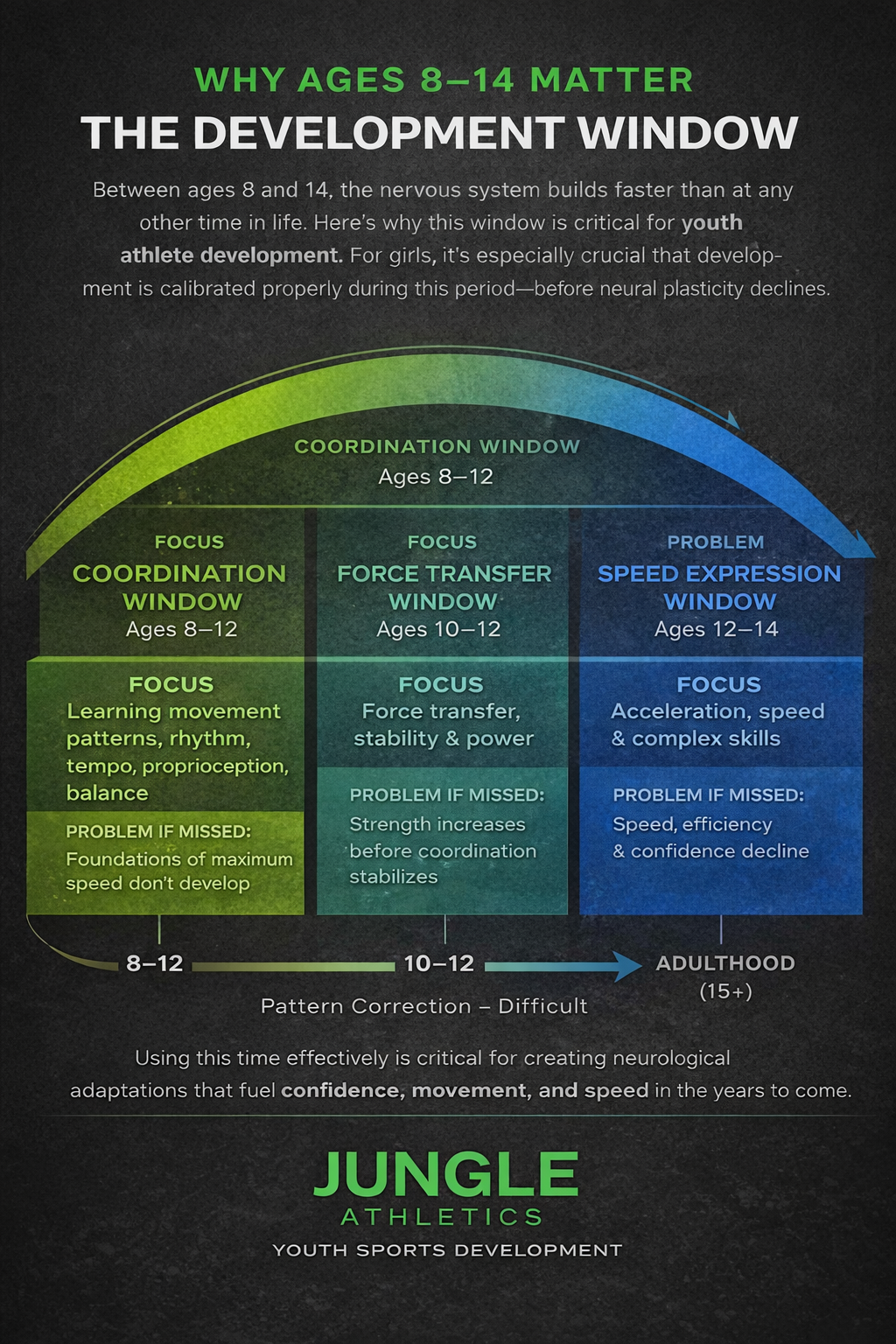
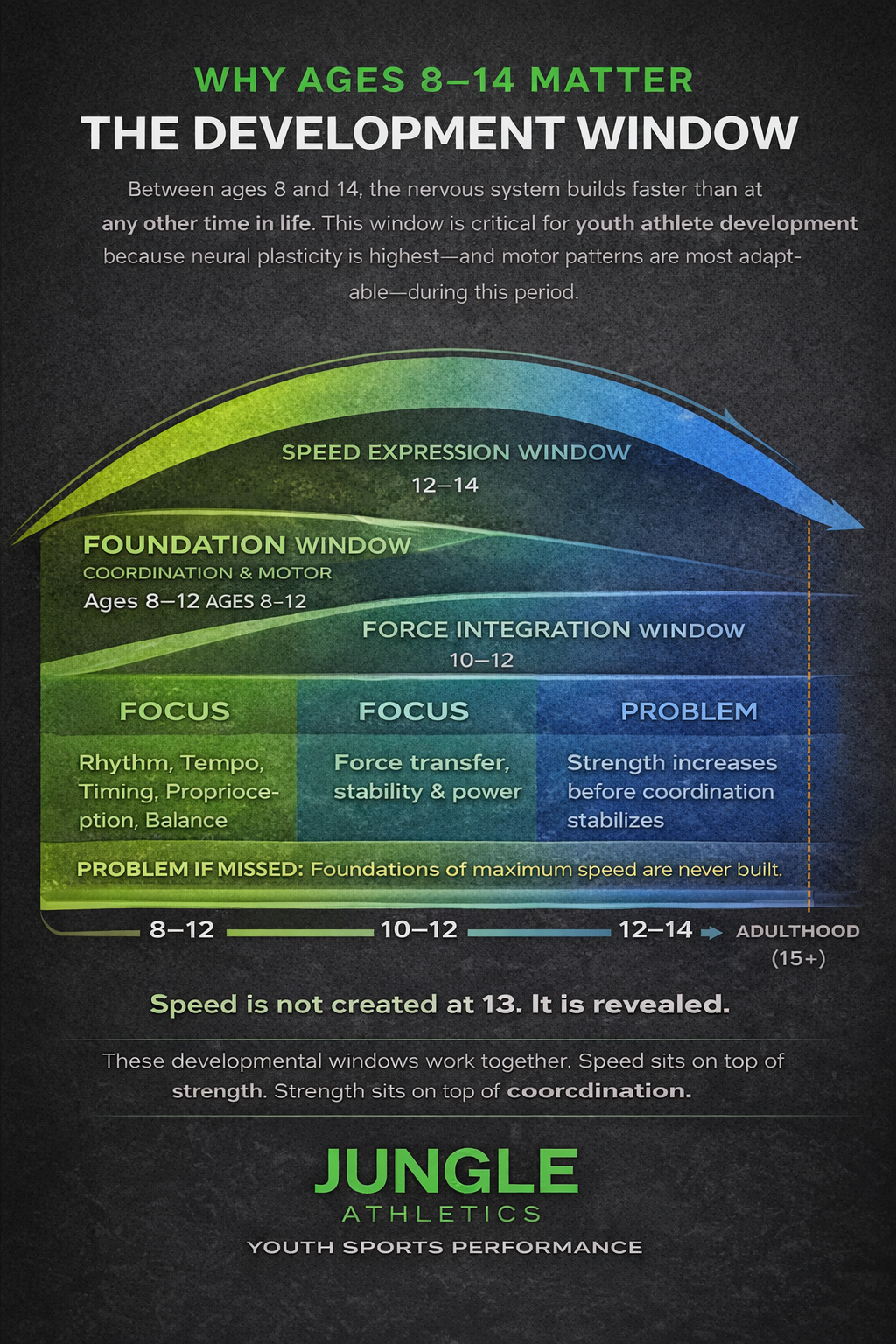
Between ages 8 and 14, your child's nervous system is building faster than at any other time in their life.
Neural plasticity is at its peak. Motor patterns are being wired, or not wired, in ways that will shape their athletic ability for decades. This isn't philosophy. It's neurology.
Different qualities develop on different timelines, and each one has a window where it adapts most efficiently. Miss it and you can still build — but never at the same rate of return. Think of development like a highway. You're driving forward. Time is passing whether you want it to or not. Along the way, there are exits. Each exit leads to a different motor quality: speed, coordination, strength, endurance.
If you take the exit at the right time, you get to explore. You build roads. You create depth. You wire the nervous system in ways that compound for years.
If you miss the exit, you cannot turn around.
You can still build later, but only from the highway. You never get the same access. You never get the same rate of return. That window is gone.
"There are windows in development that don't care how motivated you are. They don't care how disciplined you are. And they don't reopen just because you show up later with better intentions."
— Greg AlmonThis is not meant to create panic. It's meant to create clarity.
Coordination is always trainable. It compounds for life. That's the good news. But speed, the quality that most separates athletes in games, has a narrow window. And most youth training programs spend that window on the wrong things.
Greg learned this the hard way, not as a coach but as an athlete. Before building Jungle Athletics and spending four years coaching Olympic speed skaters in China, he was a kid who worked harder than almost everyone around him — and still missed the window. Then he watched his son catch everything he couldn't, not because Max worked harder, but because the timing was right.
Greg wrote about this directly in The Window That Didn't Care How Hard I Worked — the biology of why timing changes everything, told through his own development and his son's.
Why More Training
Is Making It Worse
Most youth programs run on a simple logic: train more, get better. More reps. More sessions. More ice time. It feels responsible. It usually isn't.
Strength without coordination is stiffness. When a young athlete is loaded before they can move properly, you don't build power. You cement bad patterns that carry into every game, every season, every year of their career. And a session that looks manageable on paper can devastate an athlete who arrived depleted after a tournament weekend, a growth spurt, poor sleep. The plan doesn't know that. It just runs the program.
If your athlete finishes every session exhausted, that's not a sign the training is working. It's a sign the training is drawing from the wrong account. Real development is built in the spaces between effort. Most programs only know one gear.
"Hard training builds tired athletes. Intelligent training builds faster ones."
— Greg Almon, Jungle AthleticsMost parents have never heard this: the conventional thinking is that sprinting causes hamstring injuries. The actual research says the opposite. Athletes who regularly hit near-maximum sprint speeds have significantly lower injury rates. Speed is not the risk factor. Avoiding speed is.
If your athlete has had a hamstring injury, or you're trying to prevent one, read Chaos Engineering, Sprinting & the Hamstring Problem — the Boeing factory, the winter speed gap, and why sprinting is a vaccine, not a risk factor.
Where This Comes From
In 2006, Greg Almon flew to Beijing with a single mandate: prove that a new approach to training could make Olympic athletes faster. He spent four years embedded inside China's National Short Track Speed Skating program under Li Yan, the most demanding coach in the sport. The program produced 7 Olympic Gold Medals at the 2010 Vancouver Games. Then Greg came home to Calgary and built Jungle Athletics from the ground up, one athlete at a time.
Medals
in China
Calgary Youth
Google Reviews
Greg and Charmayne Almon run the facility together. He brings the coaching science; she brings the operational backbone and the family-first culture parents feel the moment they walk in.
These principles aren't just for elite athletes. The same methods that built Team Canada players and university starters also build the 10-year-old soccer player who just wants to stop fading in the second half, or the 12-year-old hockey player who can't get low enough in their stride. The principles are the same. The application fits the athlete.
Read the full story of how Jungle Athletics began →
"Science informs. Judgment determines outcomes."
— Greg Almon